The Emperor’s New Clothes

A fairy tale by Hans Christian Andersen, 1837

Read aloud by Storyland Classics  ✦  12 min 30 sec  ✦  Watch on YouTube

🌙 Keep listening: this story is part of a longer collection. Classic Fairy Tales & Bedtime Poems (50 min), from 13:45 ↗

Two swindlers promise a vain emperor a suit of cloth so fine that only clever people can see it. No one dares admit they see nothing, until a child speaks up.

✦ The Story ✦

Read The Emperor’s New Clothes

A fairy tale by Hans Christian Andersen, 1837. Here’s how the story begins.

Many, many years ago lived an emperor, who thought so much of new clothes that he spent all his money in order to obtain them; his only ambition was to be always well dressed. He did not care for his soldiers, and the theater did not amuse him; the only thing, in fact, he thought anything of was to go out and show a new suit of clothes. He had a coat for every hour of the day; and as one would say of a king, “He is in his cabinet,” so one could say of him, “The emperor is in his dressing-room.”
Read the Full Story →

✦ About the Story ✦

The Courage to Tell the Truth

Hans Christian Andersen (1805–1875) was a Danish writer whose fairy tales have been translated into more languages than almost any other books. He published “The Emperor’s New Clothes” in 1837.

The story is about the courage to tell the truth. Every grown-up in it pretends, afraid of looking foolish, and only a child is honest enough to say what everyone can see. “The emperor has no clothes” is still used today to describe a truth that everyone is afraid to say.

✦ Talk About It ✦

Questions for Young Listeners

  • What was special about the swindlers’ cloth?
  • Why did no one say they couldn’t see the clothes?
  • Why do you think it was a child who finally told the truth?

✦ For Teachers, Homeschoolers & Families ✦

Free Story Guide

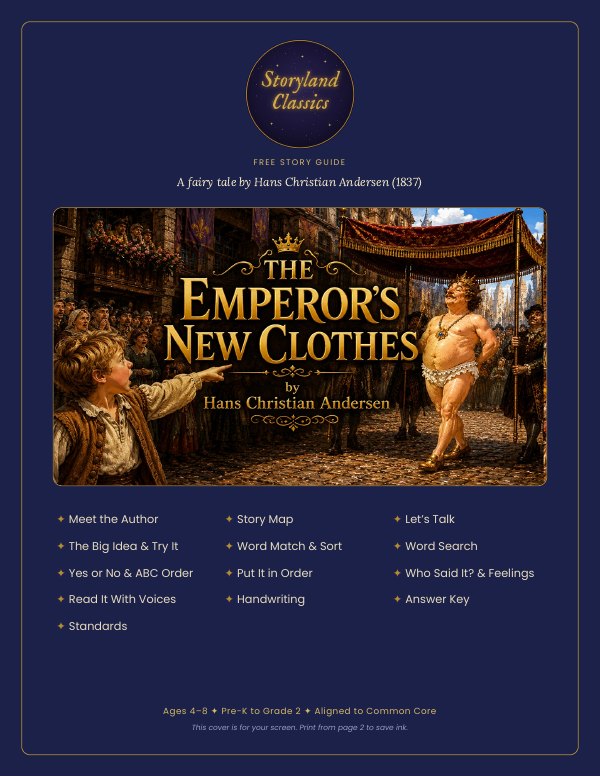
Cover of the The Emperor’s New Clothes free story guide

The 15-page Story Guide for The Emperor’s New Clothes, made for ages 4–8 (pre-K to grade 2) in the classroom, homeschool or at home. Here’s what’s inside:

  • A page for grown-ups with a story summary, a four-day plan and a QR code for the read-aloud
  • Meet the Author, with questions about the author
  • A story map with a picture from the read-aloud
  • Let’s Talk questions and a narration prompt
  • The Big Idea and a Try It activity
  • Word match, word sort and a word search
  • Yes or No? and ABC order
  • Put It in Order and a First-Next-Then-Last retelling
  • Who Said It? and a character feelings chart
  • Read It With Voices, handwriting practice, an answer key and a Common Core standards table

Standards: Common Core RL.K.1, RL.1.1, RL.2.1, RL.K.2, RL.1.2, RL.2.2, RL.K.3, RL.1.3, RL.2.3, RL.K.4, RL.K.6, RL.1.6, RL.2.6, RL.K.7, RL.1.7, RL.K.10, RL.1.10, RF.K.1b, RF.K.1d, RF.K.3c, RF.1.3, RF.1.4b, RF.2.4b, SL.K.1, SL.1.1, SL.K.2, SL.K.6, L.K.1a, L.1.1, L.1.1a, L.K.2a, L.K.4, L.1.4, L.K.5a, W.K.1, W.1.1, W.K.2, W.1.8. A full standards table is included in the guide.

Download the Free Guide (PDF)

No sign-up needed. US Letter, prints well in black and white. See all teacher guides

✦ For Grown-Ups ✦

Good to Know About The Emperor’s New Clothes

Did Andersen invent this story?

He borrowed the idea from a much older Spanish tale, written down by Don Juan Manuel in the 1300s, and gave it his own ending with the honest child.

Is The Emperor’s New Clothes suitable for young children?

Yes. The parade scene is silly rather than rude, and children love being the ones who see the truth. The read-aloud is about 12 minutes, so it suits ages 5 and up.

Who wrote The Emperor’s New Clothes?

Hans Christian Andersen, the Danish storyteller, published it in 1837.

What is the lesson of The Emperor’s New Clothes?

Tell the truth, even when everyone else is pretending. It took a child to say what everyone could see.

What can I ask children after reading it?

Why did the grown-ups pretend to see the cloth? Why did the child speak up? Have you ever been brave enough to say what was true?

Is The Emperor’s New Clothes in the public domain?

Yes. Andersen’s 1837 story and the English translation we use are in the public domain in the United States.

Wondering about public domain or classroom use? Every text on Storyland Classics is free to read and share. See our FAQ for teachers and families.

✦ Keep Reading ✦

More Stories to Enjoy

More About This AuthorMeet Hans Christian Andersen →