The Steadfast Tin Soldier

A fairy tale by Hans Christian Andersen, 1838

Read aloud by Storyland Classics  ✦  Watch on YouTube

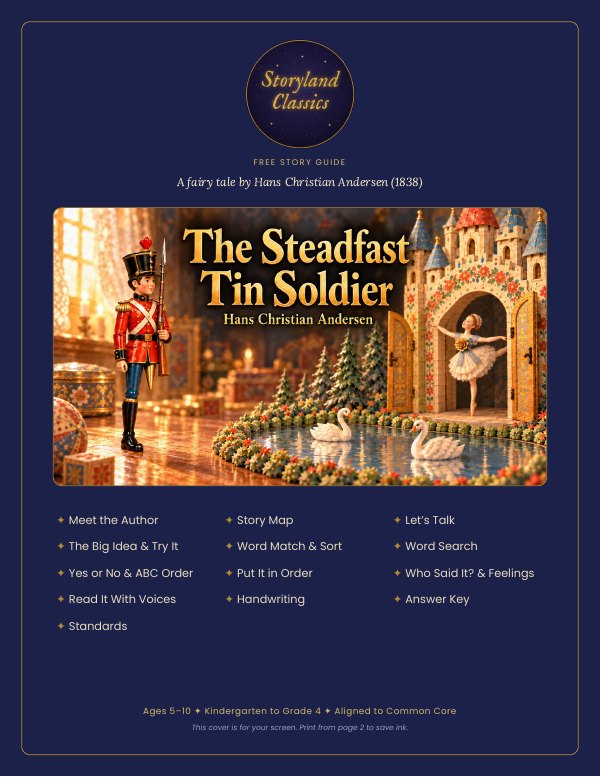
A toy soldier with only one leg falls in love with a paper ballerina. His adventures take him out the window, down the gutter, and into the belly of a fish, but he never stops standing tall. Listen to the read-aloud, read the story, or bring the story home as a read-along picture book.

📚 Teaching this story? A free 15-page story guide is below, no sign-up needed.

✦ A Living Storybook ✦

A Toy Soldier Who Never Gives Up

One leg, one brave heart, and a little paper dancer.

Hans Christian Andersen published “The Steadfast Tin Soldier” in 1838, and it has been loved ever since. Twenty-five tin soldiers stand in a box, all alike but one, who was made last and has only one leg. From the table he sees a paper ballerina in the doorway of a castle, balanced on one foot just like him, and he loses his heart to her. A fall from a window, a paper-boat ride down the gutter, a dark drain and a hungry fish follow, and through it all he stands firm and true.

At Storyland Classics, the story comes to life with gentle narration and vintage storybook illustration. A paper castle with a looking-glass lake, a rain-soaked street, and a cozy nursery accompany Lisa Bream’s warm English narration, and an unhurried pace gives the bittersweet ending room to land softly. It’s a favorite for winter evenings, homeschool literature, and anyone who remembers the story from childhood.

Read and Listen Together

Our picture book uses Andrew Lang’s 1894 text from The Yellow Fairy Book, with storybook illustrations on every page. A QR code inside links to the narrated read-aloud, so you can turn the pages and listen together. Hardcover, paperback, and Kindle. Ages 5–9. Pair it with the free printable guide below.

Storyland Classics pairs public domain literature and original narration with AI-assisted illustrations inspired by the golden age of storybook art.
✦ The Story ✦

Read The Steadfast Tin Soldier

A fairy tale by Hans Christian Andersen, 1838. Here’s how the story begins.

There were once upon a time five-and-twenty tin-soldiers—all brothers, as they were made out of the same old tin spoon. Their uniform was red and blue, and they shouldered their guns and looked straight in front of them.

The first words that they heard in this world, when the lid of the box in which they lay was taken off, were: ‘Hurrah, tin-soldiers!’ This was exclaimed by a little boy, clapping his hands; they had been given to him because it was his birthday, and now he began setting them out on the table.

Read the Full Story →

✦ About the Story ✦

Brave and True

Hans Christian Andersen published “The Steadfast Tin Soldier” in 1838. Steadfast means loyal and unshakable, and the soldier stays brave and true through every danger.

It is one of Andersen’s most beautiful and bittersweet stories. The ending is sad, but many readers find it moving rather than frightening: the soldier’s love lasts even after everything else is gone. Grown-ups may want to listen first and decide when to share it.

✦ Talk About It ✦

Questions for Young Listeners

  • What made the tin soldier different from the others?
  • What adventures did he have after he fell out of the window?
  • What does “steadfast” mean? How was the soldier steadfast?

✦ For Teachers, Homeschoolers & Families ✦

Free Teacher Guide

Cover of The Steadfast Tin Soldier Teacher & Family Guide

The 15-page Story Guide for The Steadfast Tin Soldier, made for ages 4–8 (pre-K to grade 2) in the classroom, homeschool or at home. Here’s what’s inside:

  • A page for grown-ups with a story summary, a four-day plan and a QR code for the read-aloud
  • Meet the Author, with questions about the author
  • A story map with a picture from the read-aloud
  • Let’s Talk questions and a narration prompt
  • The Big Idea and a Try It activity
  • Word match, word sort and a word search
  • Yes or No? and ABC order
  • Put It in Order and a First-Next-Then-Last retelling
  • Who Said It? and a character feelings chart
  • Read It With Voices, handwriting practice, an answer key and a Common Core standards table

Standards: Common Core RL.K.1, RL.1.1, RL.2.1, RL.K.2, RL.1.2, RL.2.2, RL.K.3, RL.1.3, RL.2.3, RL.K.4, RL.K.6, RL.1.6, RL.2.6, RL.K.7, RL.1.7, RL.K.10, RL.1.10, RF.K.1b, RF.K.1d, RF.K.3c, RF.1.3, RF.1.4b, RF.2.4b, SL.K.1, SL.1.1, SL.K.2, SL.K.6, L.K.1a, L.1.1, L.1.1a, L.K.2a, L.K.4, L.1.4, L.K.5a, W.K.1, W.1.1, W.K.2, W.1.8. A full standards table is included in the guide.

Download the Free Guide (PDF)

No sign-up needed. US Letter, prints well in black and white. See all teacher guides

✦ For Grown-Ups ✦

Good to Know About The Steadfast Tin Soldier

Why does the tin soldier have only one leg?

He was the last soldier made from an old tin spoon, and the tin ran out before his second leg was finished. He stands just as firmly as the others anyway.

What age is The Steadfast Tin Soldier best for?

Ages 5 to 9, with a grown-up nearby. The adventure is exciting, and the bittersweet ending is best shared by someone who can talk about it afterward. The picture book and teacher guides are made for this age range.

Is there a picture book of The Steadfast Tin Soldier?

Yes. The Storyland Classics read-along picture book uses Andrew Lang’s 1894 translation from The Yellow Fairy Book, illustrated on every page, with a QR code inside for the narrated read-aloud. It comes in hardcover, paperback, and Kindle.

Who wrote The Steadfast Tin Soldier?

Hans Christian Andersen, who published it in 1838.

What can I ask children after reading it?

What happened to the soldier on his journey? How did he stay brave? How do you feel about the ending?

Is The Steadfast Tin Soldier in the public domain?

Yes. Andersen’s 1838 story and the English text we use are in the public domain in the United States.

Wondering about public domain or classroom use? Every text on Storyland Classics is free to read and share. See our FAQ for teachers and families.

✦ Keep Reading ✦

More Stories to Enjoy

More About This AuthorMeet Hans Christian Andersen →