The Town Mouse and the Country Mouse

One of Aesop’s Fables

Read aloud by Storyland Classics  ✦  3 min 16 sec  ✦  Watch on YouTube

📱 Watching on a phone? Watch the full-screen vertical version ↗

🌙 Keep listening: this story is part of a longer collection. Aesop’s Fables Treasury (15 min), from 8:51 ↗

A Town Mouse visits her cousin in the country and turns up her nose at the simple food. So the Country Mouse visits the city, where the feasts are grand, but so is the danger.

✦ The Story ✦

Read the Fable: The Town Mouse and the Country Mouse

From The Æsop for Children (1919), the edition published online by the Library of Congress. Public domain.

A Town Mouse once visited a relative who lived in the country. For lunch the Country Mouse served wheat stalks, roots, and acorns, with a dash of cold water for drink. The Town Mouse ate very sparingly, nibbling a little of this and a little of that, and by her manner making it very plain that she ate the simple food only to be polite.

After the meal the friends had a long talk, or rather the Town Mouse talked about her life in the city while the Country Mouse listened. They then went to bed in a cozy nest in the hedgerow and slept in quiet and comfort until morning. In her sleep the Country Mouse dreamed she was a Town Mouse with all the luxuries and delights of city life that her friend had described for her. So the next day when the Town Mouse asked the Country Mouse to go home with her to the city, she gladly said yes.

When they reached the mansion in which the Town Mouse lived, they found on the table in the dining room the leavings of a very fine banquet. There were sweetmeats and jellies, pastries, delicious cheeses, indeed, the most tempting foods that a Mouse can imagine. But just as the Country Mouse was about to nibble a dainty bit of pastry, she heard a Cat mew loudly and scratch at the door. In great fear the Mice scurried to a hiding place, where they lay quite still for a long time, hardly daring to breathe. When at last they ventured back to the feast, the door opened suddenly and in came the servants to clear the table, followed by the House Dog.

The Country Mouse stopped in the Town Mouse’s den only long enough to pick up her carpet bag and umbrella.

“You may have luxuries and dainties that I have not,” she said as she hurried away, “but I prefer my plain food and simple life in the country with the peace and security that go with it.”

The moralPoverty with security is better than plenty in the midst of fear and uncertainty.
✦ About the Story ✦

Town or Country?

Aesop is said to have been a storyteller in ancient Greece more than 2,500 years ago. Whether or not he was a single real person, the short animal tales told under his name have been retold in almost every language, and each one ends with a lesson, or moral. This telling comes from The Æsop for Children, a 1919 collection illustrated by Milo Winter that is still a favorite with families and teachers.

“Town mouse” and “country mouse” have become everyday expressions for city people and country people. Beatrix Potter retold this fable as The Tale of Johnny Town-Mouse in 1918, just a year before The Æsop for Children was published.

✦ Talk About It ✦

Questions for Young Listeners

  • What did the Country Mouse serve for lunch?
  • What frightened the mice at the city feast?
  • Would you rather live in the town or the country? Why?

✦ For Teachers, Homeschoolers & Families ✦

Free Story Guide

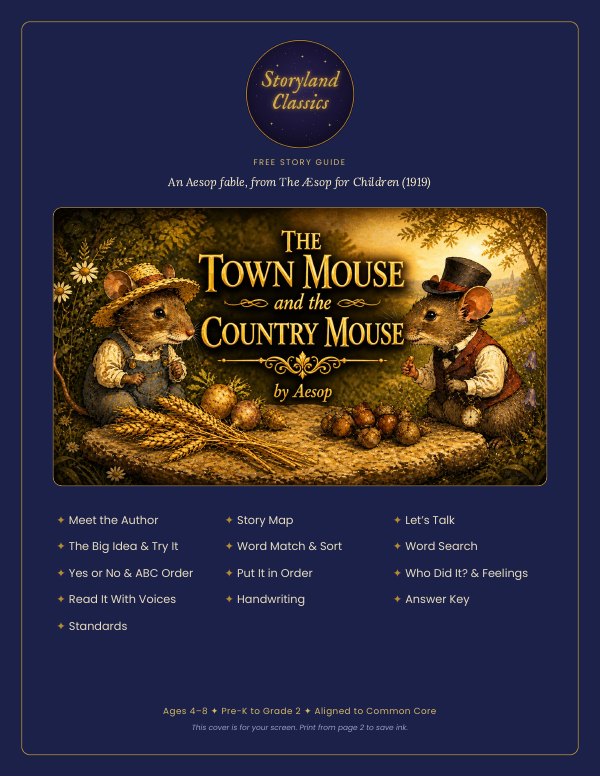
Cover of the The Town Mouse and the Country Mouse free story guide

The 15-page Story Guide for The Town Mouse and the Country Mouse, made for ages 4–8 (pre-K to grade 2) in the classroom, homeschool or at home. Here’s what’s inside:

  • A page for grown-ups with a story summary, a four-day plan and a QR code for the read-aloud
  • Meet the Author, with questions about the author
  • A story map with a picture from the read-aloud
  • Let’s Talk questions and a narration prompt
  • The Big Idea and a Try It activity
  • Word match, word sort and a word search
  • Yes or No? and ABC order
  • Put It in Order and a First-Next-Then-Last retelling
  • Who Said It? and a character feelings chart
  • Read It With Voices, handwriting practice, an answer key and a Common Core standards table

Standards: Common Core RL.K.1, RL.1.1, RL.2.1, RL.K.2, RL.1.2, RL.2.2, RL.K.3, RL.1.3, RL.2.3, RL.K.4, RL.K.6, RL.1.6, RL.2.6, RL.K.7, RL.1.7, RL.K.10, RL.1.10, RF.K.1b, RF.K.1d, RF.K.3c, RF.1.3, RF.1.4b, RF.2.4b, SL.K.1, SL.1.1, SL.K.2, SL.K.5, SL.K.6, L.K.1a, L.1.1, L.1.1a, L.K.2a, L.K.4, L.1.4, L.K.5a, W.K.1, W.1.1, W.K.2, W.1.8. A full standards table is included in the guide.

Download the Free Guide (PDF)

No sign-up needed. US Letter, prints well in black and white. See all teacher guides

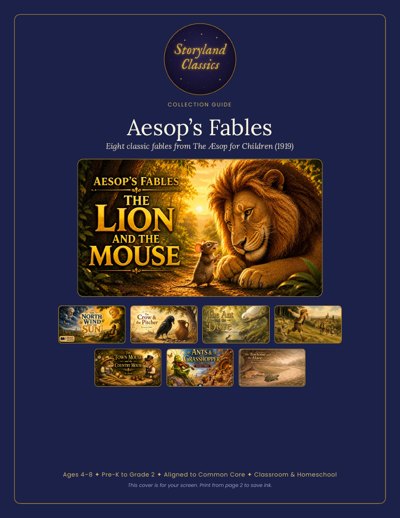
Cover of the Aesop’s Fables Collection Guide

✦ Library Card Bonus ✦

Teaching all eight fables?

Get the 84-page Aesop’s Fables Collection Guide free with your Library Card: all eight fables from the Aesop’s Fables compilation video, a two-week plan, a fable passport, six pages for every fable, activities that connect the fables, plan-and-write-your-own-fable pages, three readers’ theater scripts, a retelling rubric and certificate, full-color moral posters and answer keys.

Standards: Common Core RL.K.1, RL.1.1, RL.2.1, RL.K.2, RL.1.2, RL.2.2, RL.K.3, RL.1.3, RL.2.3, RL.K.4, RL.K.6, RL.1.6, RL.2.6, RL.K.7, RL.1.7, RL.K.10, RL.1.10, RF.K.1b, RF.K.1d, RF.K.3c, RF.1.3, RF.1.4b, RF.2.4b, SL.K.1, SL.1.1, SL.K.2, SL.K.5, SL.K.6, L.K.1a, L.1.1, L.1.1a, L.K.2a, L.K.4, L.1.4, L.K.5a, W.K.1, W.1.1, W.K.2, W.1.8. A full standards table is included in the guide.

✦ For Grown-Ups ✦

Good to Know About The Town Mouse and the Country Mouse

What is a carpet bag?

An old-fashioned traveling bag sewn from carpet fabric. The Country Mouse grabs hers, with her umbrella, and hurries straight home.

Is the Country Mouse right?

The fable says so, but children often disagree, and that is part of the fun. Ask which life they would choose and why.

Who was Aesop?

Aesop is remembered as a storyteller in ancient Greece more than 2,500 years ago, though little is known for sure about his life. His fables were passed down and retold for centuries. Our text comes from The Æsop for Children (1919), illustrated by Milo Winter.

What is the moral of The Town Mouse and the Country Mouse?

“Poverty with security is better than plenty in the midst of fear and uncertainty.” A simple, safe home can be worth more than fancy things.

What age is The Town Mouse and the Country Mouse best for?

Ages 3 to 8. Fables are short enough for the youngest listeners, and the moral gives older children something to talk about and apply to their own lives.

What can I ask children after reading it?

What did the Country Mouse like about the town? What did she not like? Where would you rather live, and why?

Is The Town Mouse and the Country Mouse in the public domain?

Yes. Aesop’s fables are ancient, and the 1919 Æsop for Children text we use is in the public domain in the United States, so it is free to read, print and share.

Wondering about public domain or classroom use? Every text on Storyland Classics is free to read and share. See our FAQ for teachers and families.

✦ Keep Reading ✦

More Stories to Enjoy

More About This AuthorMeet Aesop →