The Tortoise and the Hare

One of Aesop’s Fables

Read aloud by Storyland Classics  ✦  1 min 36 sec  ✦  Watch on YouTube

🌙 Keep listening: this story is part of a longer collection. Aesop’s Fables Treasury (15 min), from 13:39 ↗

A boastful hare challenges a slow, steady tortoise to a race, and the hare is so sure of winning that he stops for a nap. Watch the read-aloud of Aesop’s famous fable.

✦ The Story ✦

Read the Fable: The Tortoise and the Hare

From The Æsop for Children (1919), the edition published online by the Library of Congress. Public domain.

A Hare was making fun of the Tortoise one day for being so slow.

“Do you ever get anywhere?” he asked with a mocking laugh.

“Yes,” replied the Tortoise, “and I get there sooner than you think. I’ll run you a race and prove it.”

The Hare was much amused at the idea of running a race with the Tortoise, but for the fun of the thing he agreed. So the Fox, who had consented to act as judge, marked the distance and started the runners off.

The Hare was soon far out of sight, and to make the Tortoise feel very deeply how ridiculous it was for him to try a race with a Hare, he lay down beside the course to take a nap until the Tortoise should catch up.

The Tortoise meanwhile kept going slowly but steadily, and, after a time, passed the place where the Hare was sleeping. But the Hare slept on very peacefully; and when at last he did wake up, the Tortoise was near the goal. The Hare now ran his swiftest, but he could not overtake the Tortoise in time.

The moralThe race is not always to the swift.
✦ About the Story ✦

About Aesop’s Fables

Aesop is said to have been a storyteller in ancient Greece more than 2,500 years ago. Whether or not he was a single real person, the short animal tales collected under his name have been retold in almost every language, and each one ends with a lesson, or moral.

“The Tortoise and the Hare” may be the most famous of them all. This telling comes from The Æsop for Children, a 1919 collection illustrated by Milo Winter that is still a favorite with families and teachers. Its lesson is that steady effort beats talent that doesn’t try, and that being too sure of yourself can be your downfall.

✦ Talk About It ✦

Questions for Young Listeners

  • Why did the hare stop to take a nap? Was that a good idea?
  • The tortoise knew he was slow. Why do you think he raced anyway?
  • Can you think of a time when going slow and steady helped you finish something?

✦ For Teachers, Homeschoolers & Families ✦

Free Story Guide

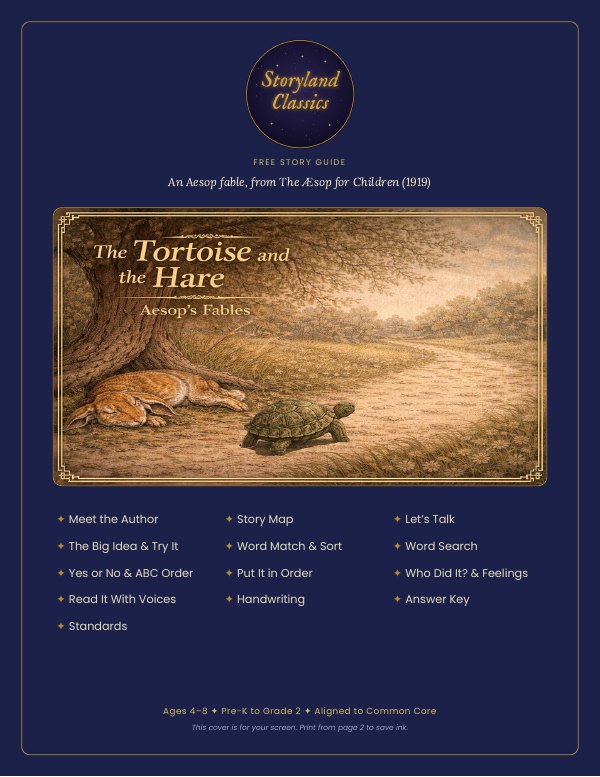
Cover of the The Tortoise and the Hare free story guide

The 15-page Story Guide for The Tortoise and the Hare, made for ages 4–8 (pre-K to grade 2) in the classroom, homeschool or at home. Here’s what’s inside:

  • A page for grown-ups with a story summary, a four-day plan and a QR code for the read-aloud
  • Meet the Author, with questions about the author
  • A story map with a picture from the read-aloud
  • Let’s Talk questions and a narration prompt
  • The Big Idea and a Try It activity
  • Word match, word sort and a word search
  • Yes or No? and ABC order
  • Put It in Order and a First-Next-Then-Last retelling
  • Who Said It? and a character feelings chart
  • Read It With Voices, handwriting practice, an answer key and a Common Core standards table

Standards: Common Core RL.K.1, RL.1.1, RL.2.1, RL.K.2, RL.1.2, RL.2.2, RL.K.3, RL.1.3, RL.2.3, RL.K.4, RL.K.6, RL.1.6, RL.2.6, RL.K.7, RL.1.7, RL.K.10, RL.1.10, RF.K.1b, RF.K.1d, RF.K.3c, RF.1.3, RF.1.4b, RF.2.4b, SL.K.1, SL.1.1, SL.K.2, SL.K.6, L.K.1a, L.1.1, L.1.1a, L.K.2a, L.K.4, L.1.4, L.K.5a, W.K.1, W.1.1, W.K.2, W.1.8. A full standards table is included in the guide.

Download the Free Guide (PDF)

No sign-up needed. US Letter, prints well in black and white. See all teacher guides

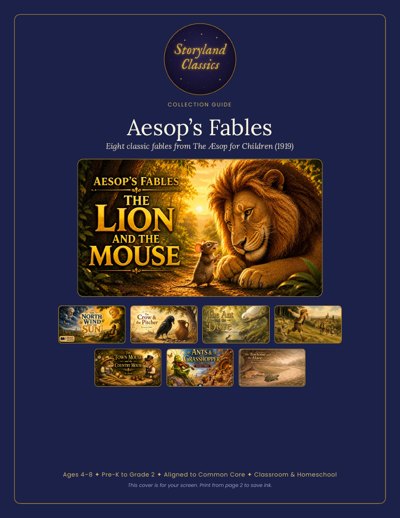
Cover of the Aesop’s Fables Collection Guide

✦ Library Card Bonus ✦

Teaching all eight fables?

Get the 84-page Aesop’s Fables Collection Guide free with your Library Card: all eight fables from the Aesop’s Fables compilation video, a two-week plan, a fable passport, six pages for every fable, activities that connect the fables, plan-and-write-your-own-fable pages, three readers’ theater scripts, a retelling rubric and certificate, full-color moral posters and answer keys.

Standards: Common Core RL.K.1, RL.1.1, RL.2.1, RL.K.2, RL.1.2, RL.2.2, RL.K.3, RL.1.3, RL.2.3, RL.K.4, RL.K.6, RL.1.6, RL.2.6, RL.K.7, RL.1.7, RL.K.10, RL.1.10, RF.K.1b, RF.K.1d, RF.K.3c, RF.1.3, RF.1.4b, RF.2.4b, SL.K.1, SL.1.1, SL.K.2, SL.K.6, L.K.1a, L.1.1, L.1.1a, L.K.2a, L.K.4, L.1.4, L.K.5a, W.K.1, W.1.1, W.K.2, W.1.8. A full standards table is included in the guide.

✦ For Grown-Ups ✦

Good to Know About The Tortoise and the Hare

Who judges the race?

The Fox. He marks out the course and starts the runners off, which is a small detail many retellings leave out.

What does “the race is not always to the swift” mean?

Being fast is not enough to win if you don’t keep going. The words echo a famous line from the Bible’s Book of Ecclesiastes.

Who was Aesop?

Aesop is remembered as a storyteller in ancient Greece more than 2,500 years ago, though little is known for sure about his life. His fables were passed down and retold for centuries. Our text comes from The Æsop for Children (1919), illustrated by Milo Winter.

What age is The Tortoise and the Hare best for?

Ages 3 to 8. Fables are short enough for the youngest listeners, and the moral gives older children something to talk about and apply to their own lives.

What can I ask children after reading it?

Why did the Hare lose? What could he have done differently? Have you ever kept going at something slow and hard until you finished?

Is The Tortoise and the Hare in the public domain?

Yes. Aesop’s fables are ancient, and the 1919 Æsop for Children text we use is in the public domain in the United States, so it is free to read, print and share.

Wondering about public domain or classroom use? Every text on Storyland Classics is free to read and share. See our FAQ for teachers and families.

✦ Keep Reading ✦

More Stories to Enjoy

More About This AuthorMeet Aesop →