The Owl and the Grasshopper

One of Aesop’s Fables

Read aloud by Storyland Classics  ✦  3 min 44 sec  ✦  Watch on YouTube

A cross old Owl wants to sleep, but a saucy Grasshopper keeps singing outside her oak tree. So the wise Owl tries flattery instead of hard words.

✦ The Story ✦

Read the Fable: The Owl and the Grasshopper

From The Æsop for Children (1919), the edition published online by the Library of Congress. Public domain.

The Owl always takes her sleep during the day. Then after sundown, when the rosy light fades from the sky and the shadows rise slowly through the wood, out she comes ruffling and blinking from the old hollow tree. Now her weird “hoo-hoo-hoo-oo-oo” echoes through the quiet wood, and she begins her hunt for the bugs and beetles, frogs and mice she likes so well to eat.

Now there was a certain old Owl who had become very cross and hard to please as she grew older, especially if anything disturbed her daily slumbers. One warm summer afternoon as she dozed away in her den in the old oak tree, a Grasshopper nearby began a joyous but very raspy song. Out popped the old Owl’s head from the opening in the tree that served her both for door and for window.

“Get away from here, sir,” she said to the Grasshopper. “Have you no manners? You should at least respect my age and leave me to sleep in quiet!”

But the Grasshopper answered saucily that he had as much right to his place in the sun as the Owl had to her place in the old oak. Then he struck up a louder and still more rasping tune.

The wise old Owl knew quite well that it would do no good to argue with the Grasshopper, nor with anybody else for that matter. Besides, her eyes were not sharp enough by day to permit her to punish the Grasshopper as he deserved. So she laid aside all hard words and spoke very kindly to him.

“Well sir,” she said, “if I must stay awake, I am going to settle right down to enjoy your singing. Now that I think of it, I have a wonderful wine here, sent me from Olympus, of which I am told Apollo drinks before he sings to the high gods. Please come up and taste this delicious drink with me. I know it will make you sing like Apollo himself.”

The foolish Grasshopper was taken in by the Owl’s flattering words. Up he jumped to the Owl’s den, but as soon as he was near enough so the old Owl could see him clearly, she pounced upon him and ate him up.

The moralFlattery is not a proof of true admiration. Do not let flattery throw you off your guard against an enemy.
✦ About the Story ✦

Beware of Flattery

Aesop is said to have been a storyteller in ancient Greece more than 2,500 years ago. Whether or not he was a single real person, the short animal tales told under his name have been retold in almost every language, and each one ends with a lesson, or moral. This telling comes from The Æsop for Children, a 1919 collection illustrated by Milo Winter that is still a favorite with families and teachers.

Flattery means praising someone too much, usually to get something from them. The Grasshopper should have been suspicious when the cross old Owl suddenly became so friendly. Apollo, mentioned in the story, was the Greek god of music.

✦ Talk About It ✦

Questions for Young Listeners

  • Why was the Owl cross with the Grasshopper?
  • How did the Owl trick the Grasshopper?
  • What is flattery? Why should we be careful when someone flatters us?

✦ For Teachers, Homeschoolers & Families ✦

Free Story Guide

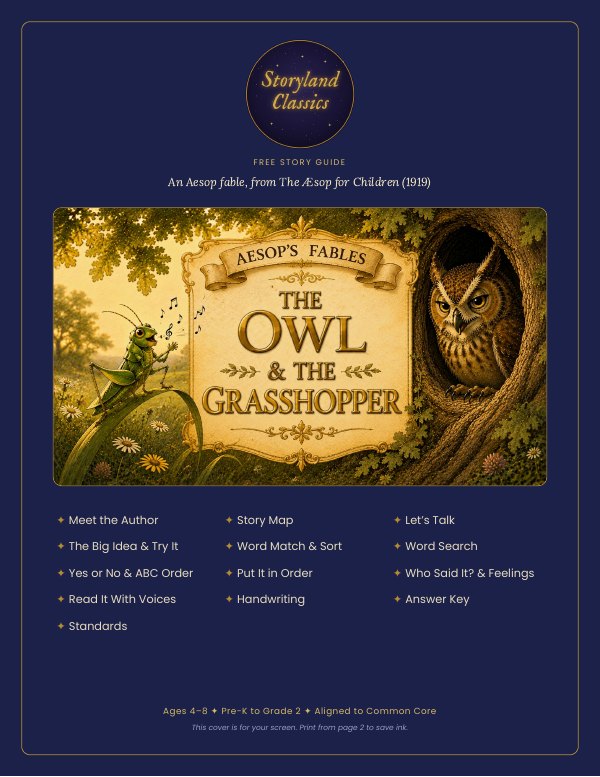
Cover of the The Owl and the Grasshopper free story guide

The 15-page Story Guide for The Owl and the Grasshopper, made for ages 4–8 (pre-K to grade 2) in the classroom, homeschool or at home. Here’s what’s inside:

  • A page for grown-ups with a story summary, a four-day plan and a QR code for the read-aloud
  • Meet the Author, with questions about the author
  • A story map with a picture from the read-aloud
  • Let’s Talk questions and a narration prompt
  • The Big Idea and a Try It activity
  • Word match, word sort and a word search
  • Yes or No? and ABC order
  • Put It in Order and a First-Next-Then-Last retelling
  • Who Said It? and a character feelings chart
  • Read It With Voices, handwriting practice, an answer key and a Common Core standards table

Standards: Common Core RL.K.1, RL.1.1, RL.2.1, RL.K.2, RL.1.2, RL.2.2, RL.K.3, RL.1.3, RL.2.3, RL.K.4, RL.K.6, RL.1.6, RL.2.6, RL.K.7, RL.1.7, RL.K.10, RL.1.10, RF.K.1b, RF.K.1d, RF.K.3c, RF.1.3, RF.1.4b, RF.2.4b, SL.K.1, SL.1.1, SL.K.2, SL.K.6, L.K.1a, L.1.1, L.1.1a, L.K.2a, L.K.4, L.1.4, L.K.5a, W.K.1, W.1.1, W.K.2, W.1.8. A full standards table is included in the guide.

Download the Free Guide (PDF)

No sign-up needed. US Letter, prints well in black and white. See all teacher guides

✦ For Grown-Ups ✦

Good to Know About The Owl and the Grasshopper

Is the ending too harsh for young children?

The Owl pounces and eats the Grasshopper, as owls do. Like many of Aesop’s fables it is matter-of-fact rather than frightening, but you may want to preview it with very young listeners.

What is Olympus?

Mount Olympus, the highest mountain in Greece, was said to be the home of the Greek gods. The Owl claims her wine comes from there to make the Grasshopper feel important.

Who was Aesop?

Aesop is remembered as a storyteller in ancient Greece more than 2,500 years ago, though little is known for sure about his life. His fables were passed down and retold for centuries. Our text comes from The Æsop for Children (1919), illustrated by Milo Winter.

What is the moral of The Owl and the Grasshopper?

“Flattery is not a proof of true admiration. Do not let flattery throw you off your guard against an enemy.”

What age is The Owl and the Grasshopper best for?

Ages 3 to 8. Fables are short enough for the youngest listeners, and the moral gives older children something to talk about and apply to their own lives.

What can I ask children after reading it?

Why was the Owl cross with the Grasshopper? How did the Owl trick him? What is the difference between a real compliment and flattery?

Is The Owl and the Grasshopper in the public domain?

Yes. Aesop’s fables are ancient, and the 1919 Æsop for Children text we use is in the public domain in the United States, so it is free to read, print and share.

Wondering about public domain or classroom use? Every text on Storyland Classics is free to read and share. See our FAQ for teachers and families.

✦ Keep Reading ✦

More Stories to Enjoy

More About This AuthorMeet Aesop →