The North Wind and the Sun

One of Aesop’s Fables

Read aloud by Storyland Classics  ✦  2 min 20 sec  ✦  Watch on YouTube

🌙 Keep listening: this story is part of a longer collection. Aesop’s Fables Treasury (15 min), from 2:09 ↗

The North Wind and the Sun argue about who is stronger, and agree on a test: whoever can make a traveler take off his cloak wins.

✦ The Story ✦

Read the Fable: The North Wind and the Sun

From The Æsop for Children (1919), the edition published online by the Library of Congress. Public domain.

The North Wind and the Sun had a quarrel about which of them was the stronger. While they were disputing with much heat and bluster, a Traveler passed along the road wrapped in a cloak.

“Let us agree,” said the Sun, “that he is the stronger who can strip that Traveler of his cloak.”

“Very well,” growled the North Wind, and at once sent a cold, howling blast against the Traveler.

With the first gust of wind the ends of the cloak whipped about the Traveler’s body. But he immediately wrapped it closely around him, and the harder the Wind blew, the tighter he held it to him. The North Wind tore angrily at the cloak, but all his efforts were in vain.

Then the Sun began to shine. At first his beams were gentle, and in the pleasant warmth after the bitter cold of the North Wind, the Traveler unfastened his cloak and let it hang loosely from his shoulders. The Sun’s rays grew warmer and warmer. The man took off his cap and mopped his brow. At last he became so heated that he pulled off his cloak, and, to escape the blazing sunshine, threw himself down in the welcome shade of a tree by the roadside.

The moralGentleness and kind persuasion win where force and bluster fail.
✦ About the Story ✦

Gentle Is Strong

Aesop is said to have been a storyteller in ancient Greece more than 2,500 years ago. Whether or not he was a single real person, the short animal tales told under his name have been retold in almost every language, and each one ends with a lesson, or moral. This telling comes from The Æsop for Children, a 1919 collection illustrated by Milo Winter that is still a favorite with families and teachers.

This fable is so short and clear that language scholars use it as a standard passage for recording how different languages sound. Its lesson, that gentleness often works better than force, is useful at every age.

✦ Talk About It ✦

Questions for Young Listeners

  • What did the North Wind and the Sun argue about?
  • What happened when the Wind blew harder?
  • Can you think of a time when being gentle worked better than being forceful?

✦ For Teachers, Homeschoolers & Families ✦

Free Story Guide

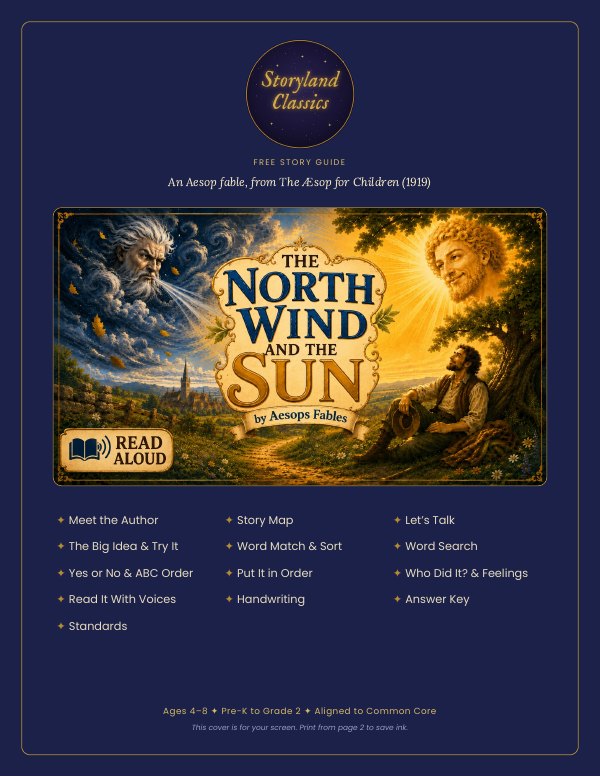
Cover of the The North Wind and the Sun free story guide

The 15-page Story Guide for The North Wind and the Sun, made for ages 4–8 (pre-K to grade 2) in the classroom, homeschool or at home. Here’s what’s inside:

  • A page for grown-ups with a story summary, a four-day plan and a QR code for the read-aloud
  • Meet the Author, with questions about the author
  • A story map with a picture from the read-aloud
  • Let’s Talk questions and a narration prompt
  • The Big Idea and a Try It activity
  • Word match, word sort and a word search
  • Yes or No? and ABC order
  • Put It in Order and a First-Next-Then-Last retelling
  • Who Said It? and a character feelings chart
  • Read It With Voices, handwriting practice, an answer key and a Common Core standards table

Standards: Common Core RL.K.1, RL.1.1, RL.2.1, RL.K.2, RL.1.2, RL.2.2, RL.K.3, RL.1.3, RL.2.3, RL.K.4, RL.K.6, RL.1.6, RL.2.6, RL.K.7, RL.1.7, RL.K.10, RL.1.10, RF.K.1b, RF.K.1d, RF.K.3c, RF.1.3, RF.1.4b, RF.2.4b, SL.K.1, SL.1.1, SL.K.2, SL.K.5, SL.K.6, L.K.1a, L.1.1, L.1.1a, L.K.2a, L.K.4, L.1.4, L.K.5a, W.K.1, W.1.1, W.K.2, W.1.8. A full standards table is included in the guide.

Download the Free Guide (PDF)

No sign-up needed. US Letter, prints well in black and white. See all teacher guides

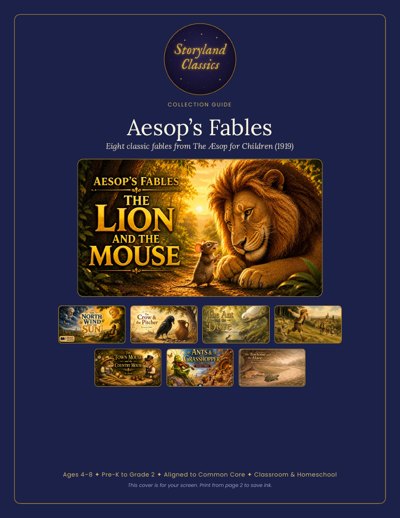
Cover of the Aesop’s Fables Collection Guide

✦ Library Card Bonus ✦

Teaching all eight fables?

Get the 84-page Aesop’s Fables Collection Guide free with your Library Card: all eight fables from the Aesop’s Fables compilation video, a two-week plan, a fable passport, six pages for every fable, activities that connect the fables, plan-and-write-your-own-fable pages, three readers’ theater scripts, a retelling rubric and certificate, full-color moral posters and answer keys.

Standards: Common Core RL.K.1, RL.1.1, RL.2.1, RL.K.2, RL.1.2, RL.2.2, RL.K.3, RL.1.3, RL.2.3, RL.K.4, RL.K.6, RL.1.6, RL.2.6, RL.K.7, RL.1.7, RL.K.10, RL.1.10, RF.K.1b, RF.K.1d, RF.K.3c, RF.1.3, RF.1.4b, RF.2.4b, SL.K.1, SL.1.1, SL.K.2, SL.K.5, SL.K.6, L.K.1a, L.1.1, L.1.1a, L.K.2a, L.K.4, L.1.4, L.K.5a, W.K.1, W.1.1, W.K.2, W.1.8. A full standards table is included in the guide.

✦ For Grown-Ups ✦

Good to Know About The North Wind and the Sun

Who wins the contest?

The Sun. The harder the Wind blows, the tighter the traveler holds his cloak, but the Sun’s warmth makes him take it off on his own.

How can children act out this fable?

One child is the traveler wrapped in a blanket, one is the Wind huffing and puffing, and one is the Sun beaming. It takes two minutes and makes the lesson unforgettable.

Who was Aesop?

Aesop is remembered as a storyteller in ancient Greece more than 2,500 years ago, though little is known for sure about his life. His fables were passed down and retold for centuries. Our text comes from The Æsop for Children (1919), illustrated by Milo Winter.

What is the moral of The North Wind and the Sun?

“Gentleness and kind persuasion win where force and bluster fail.”

What age is The North Wind and the Sun best for?

Ages 3 to 8. Fables are short enough for the youngest listeners, and the moral gives older children something to talk about and apply to their own lives.

What can I ask children after reading it?

Why did the traveler wrap his cloak tighter in the wind? Why did he take it off in the sun? When is being gentle better than being strong?

Is The North Wind and the Sun in the public domain?

Yes. Aesop’s fables are ancient, and the 1919 Æsop for Children text we use is in the public domain in the United States, so it is free to read, print and share.

Wondering about public domain or classroom use? Every text on Storyland Classics is free to read and share. See our FAQ for teachers and families.

✦ Keep Reading ✦

More Stories to Enjoy

More About This AuthorMeet Aesop →