The Little Red Hen

A traditional folktale, retold by Florence White Williams, 1918

Read aloud by Storyland Classics  ✦  9 min 01 sec  ✦  Watch on YouTube

📱 Watching on a phone? Watch the full-screen vertical version ↗

🌙 Keep listening: this story is part of a longer collection. Classic Fairy Tales & Bedtime Poems (50 min), from 38:33 ↗

The Little Red Hen finds a grain of wheat and asks her friends to help plant it. “Not I,” says the cat, the dog, and the duck. But who will help her eat the bread?

✦ The Story ✦

Read The Little Red Hen

A traditional folktale. Here’s how the story begins.

A little red hen lived in a barnyard. She spent almost all of her time walking about the barnyard in her picketty-pecketty fashion, scratching everywhere for worms.

She dearly loved fat, delicious worms and felt that they were absolutely necessary to the health of her children. As often as she found a worm, she would call “Chuck-chuck-chuck!” to her chickies. When they were gathered about her, she would distribute choice morsels of her tidbit. A busy little body was she!
Read the Full Story →

✦ About the Story ✦

From Seed to Bread

“The Little Red Hen” is a traditional folktale that became a favorite in American school readers in the late 1800s and early 1900s. Its repeating pattern makes it one of the best stories for young children learning to read along.

The story follows wheat all the way from seed to bread, and its lesson is simple: those who help with the work can share in the reward.

✦ Talk About It ✦

Questions for Young Listeners

  • What did the Little Red Hen find?
  • What steps did it take to turn wheat into bread?
  • Was it fair that the Little Red Hen ate the bread herself? Why?

✦ For Teachers, Homeschoolers & Families ✦

Free Story Guide

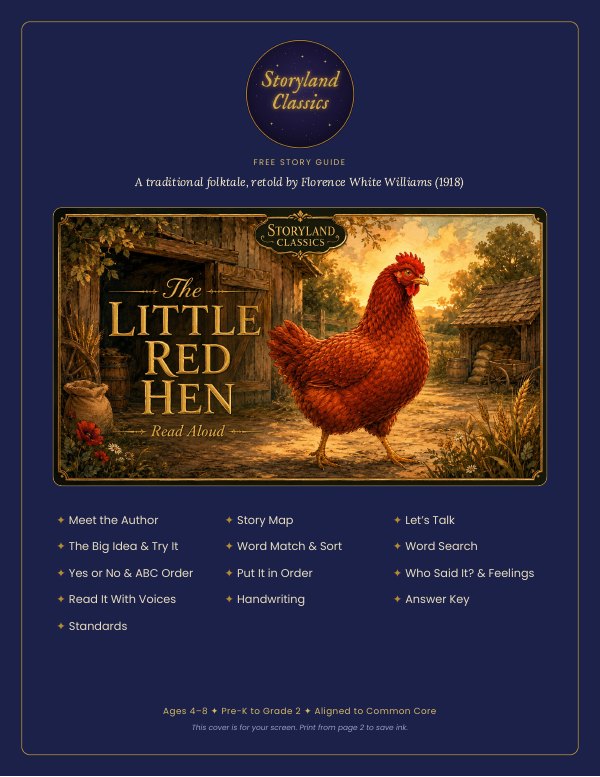
Cover of the The Little Red Hen free story guide

The 15-page Story Guide for The Little Red Hen, made for ages 4–8 (pre-K to grade 2) in the classroom, homeschool or at home. Here’s what’s inside:

  • A page for grown-ups with a story summary, a four-day plan and a QR code for the read-aloud
  • Meet the Author, with questions about the author
  • A story map with a picture from the read-aloud
  • Let’s Talk questions and a narration prompt
  • The Big Idea and a Try It activity
  • Word match, word sort and a word search
  • Yes or No? and ABC order
  • Put It in Order and a First-Next-Then-Last retelling
  • Who Said It? and a character feelings chart
  • Read It With Voices, handwriting practice, an answer key and a Common Core standards table

Standards: Common Core RL.K.1, RL.1.1, RL.2.1, RL.K.2, RL.1.2, RL.2.2, RL.K.3, RL.1.3, RL.2.3, RL.K.4, RL.K.6, RL.1.6, RL.2.6, RL.K.7, RL.1.7, RL.K.10, RL.1.10, RF.K.1b, RF.K.1d, RF.K.3c, RF.1.3, RF.1.4b, RF.2.4b, SL.K.1, SL.1.1, SL.K.2, SL.K.5, SL.K.6, L.K.1a, L.1.1, L.1.1a, L.K.2a, L.K.4, L.1.4, L.K.5a, W.K.1, W.1.1, W.K.2, W.1.8. A full standards table is included in the guide.

Download the Free Guide (PDF)

No sign-up needed. US Letter, prints well in black and white. See all teacher guides

✦ For Grown-Ups ✦

Good to Know About The Little Red Hen

How can children join in?

Let them say “Not I!” for the cat, the dog, and the duck. By the second time around they will be waiting for it, and the change at the end lands as a happy surprise.

What activities go well with this story?

Bake a simple loaf of bread together and talk about each step from seed to slice, or act the story out with one child as the Hen and others as her lazy friends.

Who wrote The Little Red Hen?

It is a traditional folktale told for generations. Our text is the 1918 telling by Florence White Williams.

What is the lesson of The Little Red Hen?

Those who share the work share the reward. It is a story about helping and doing your part.

What age is The Little Red Hen best for?

Ages 2 to 6. The repeated “Not I!” makes it a favorite for joining in.

What can I ask children after reading it?

Who helped the Little Red Hen? Was she fair at the end? How do you help at home?

Is The Little Red Hen in the public domain?

Yes. The folktale is traditional, and the 1918 text we use is in the public domain in the United States.

Wondering about public domain or classroom use? Every text on Storyland Classics is free to read and share. See our FAQ for teachers and families.

✦ Keep Reading ✦

More Stories to Enjoy

More About This AuthorMeet Florence White Williams →