The Little Engine That Could

Retold by Watty Piper, 1930

Read aloud by Storyland Classics  ✦  8 min 30 sec  ✦  Watch on YouTube

📱 Watching on a phone? Watch the full-screen vertical version ↗

🌙 Keep listening: this story is part of a longer collection. Classic Fairy Tales & Bedtime Poems (50 min), from 3:15 ↗

A train full of toys and good food breaks down before a high mountain. The big engines refuse to help, until a little blue engine says, “I think I can.”

📚 Teaching this story? A free 15-page story guide is below, no sign-up needed.

✦ A Living Storybook ✦

A Classic Read-Aloud, Reimagined

“I think I can. I think I can.”

For nearly a century, those simple words have encouraged children to keep trying. The Little Engine That Could, retold by Watty Piper and published in 1930, became a beloved American classic: a story about determination, kindness, and finding courage when a task seems too big.

Watty Piper was the pen name of Arnold Munk of the publishing firm Platt & Munk, though versions of the tale were told as early as the 1900s. Its little blue engine, who pulls a stranded train of toys over the mountain, has been shared by parents, grandparents, and teachers ever since.

At Storyland Classics, the story comes to life with gentle narration and vintage storybook illustration. Expressive engines, cheerful toys, and glowing mountain landscapes accompany Lisa Bream’s warm English narration, and soft animation and an unhurried pace make it feel like sitting down with a beautifully illustrated book.

Watch the read-aloud above for a cozy family story time, a homeschool literature lesson, or a quiet moment with a childhood favorite. Its hopeful refrain invites little listeners to join in, and the story opens easy conversations about helping others, perseverance, and trying something new.

Read and Listen Together

Our illustrated edition brings the adventure to your bookshelf. A QR code inside the print book links to the narrated read-aloud, so you can turn the pages and listen together. Hardcover, paperback, and Kindle. Ages 3–8.

Storyland Classics pairs public domain literature and original narration with AI-assisted illustrations inspired by the golden age of storybook art.
✦ The Story ✦

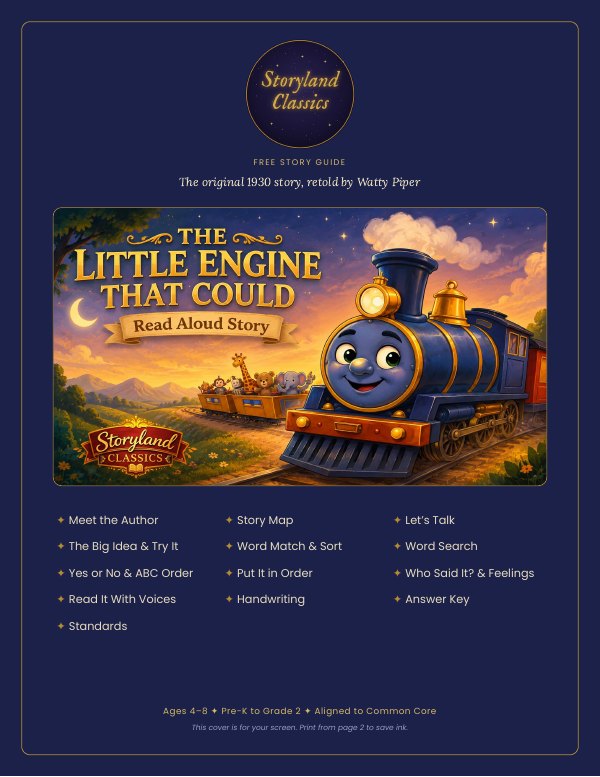
Read The Little Engine That Could

Retold by Watty Piper, 1930. Here’s how the story begins.

The little train rumbled over the tracks. She was a happy little train, for she had such a jolly load to carry. Her cars were filled full of good things for boys and girls.

There were toy animals: giraffes with long necks, teddy bears with almost no necks at all, and even a baby elephant. Then there were dolls: dolls with blue eyes and yellow curls, dolls with brown eyes and brown bobbed heads, and the sweetest little toy clown you ever saw.

Read the Full Story →

✦ Talk About It ✦

Questions for Young Listeners

  • Why did the other engines refuse to help?
  • What did the little engine say as she climbed the mountain?
  • When is a time you said “I think I can” and did something hard?

✦ For Teachers, Homeschoolers & Families ✦

Free Teacher Guide

Cover of The Little Engine That Could Teacher & Family Guide

The 15-page Story Guide for The Little Engine That Could, made for ages 4–8 (pre-K to grade 2) in the classroom, homeschool or at home. Here’s what’s inside:

  • A page for grown-ups with a story summary, a four-day plan and a QR code for the read-aloud
  • Meet the Author, with questions about the author
  • A story map with a picture from the read-aloud
  • Let’s Talk questions and a narration prompt
  • The Big Idea and a Try It activity
  • Word match, word sort and a word search
  • Yes or No? and ABC order
  • Put It in Order and a First-Next-Then-Last retelling
  • Who Said It? and a character feelings chart
  • Read It With Voices, handwriting practice, an answer key and a Common Core standards table

Standards: Common Core RL.K.1, RL.1.1, RL.2.1, RL.K.2, RL.1.2, RL.2.2, RL.K.3, RL.1.3, RL.2.3, RL.K.4, RL.K.6, RL.1.6, RL.2.6, RL.K.7, RL.1.7, RL.K.10, RL.1.10, RF.K.1b, RF.K.1d, RF.K.3c, RF.1.3, RF.1.4b, RF.2.4b, SL.K.1, SL.1.1, SL.K.2, SL.K.5, SL.K.6, L.K.1a, L.1.1, L.1.1a, L.K.2a, L.K.4, L.1.4, L.K.5a, W.K.1, W.1.1, W.K.2, W.1.8. A full standards table is included in the guide.

Download the Free Guide (PDF)

No sign-up needed. US Letter, prints well in black and white. See all teacher guides

✦ Did You Know? ✦

Watty Piper Wasn’t a Real Person

“Watty Piper” was a pen name used by Arnold Munk, co-owner of the New York publisher Platt & Munk. The 1930 book says it was “retold by Watty Piper from The Pony Engine by Mabel C. Bragg,” a Boston teacher who never claimed to have invented the story herself. An even earlier version, “The Pony Engine,” appeared in a teachers’ magazine in 1910.

✦ For Grown-Ups ✦

Good to Know About The Little Engine That Could

Who was Watty Piper?

A pen name used by the publisher Arnold Munk of Platt & Munk, who released the book in 1930. The name appeared on many of the company’s children’s books.

Is the story older than 1930?

Yes. Versions of a little engine that thinks it can were told in the early 1900s. Piper’s 1930 telling, with the toy-filled train and the famous “I think I can,” is the one that became a classic.

Is there a picture book of this read-aloud?

Yes. The Storyland Classics edition has the complete story with vintage-storybook illustrations and a QR code for the narrated read-aloud, in hardcover, paperback, and on Kindle.

Was Watty Piper a real person?

No. Watty Piper was a pen name used by Arnold Munk, co-owner of the publisher Platt & Munk. The 1930 book was “retold by Watty Piper from The Pony Engine by Mabel C. Bragg.”

Who first wrote The Little Engine That Could?

No single person. A version called “The Pony Engine” appeared in a teachers’ magazine in 1910, Mabel C. Bragg retold it in 1916, and Platt & Munk’s 1930 book made it famous.

What is the lesson of The Little Engine That Could?

Believe in yourself and keep trying, and be willing to help others even when the job looks too big. “I think I can” is a good thing to say when something is hard.

What age is The Little Engine That Could best for?

Ages 2 to 7. The repeating “I think I can” lets even the youngest listeners join in.

What can I ask children after reading it?

Why wouldn’t the big engines help? How did the Little Blue Engine get up the mountain? When have you said “I think I can”?

Wondering about public domain or classroom use? Every text on Storyland Classics is free to read and share. See our FAQ for teachers and families.

✦ Keep Reading ✦

More Stories to Enjoy

More About This AuthorMeet Watty Piper →