The Dove and the Ant

One of Aesop’s Fables

Read aloud by Storyland Classics  ✦  59 seconds  ✦  Watch on YouTube

🌙 Keep listening: this story is part of a longer collection. Aesop’s Fables Treasury (15 min), from 5:31 ↗

A Dove saves a drowning Ant with a blade of straw. Soon after, the tiny Ant finds a way to save the Dove.

✦ The Story ✦

Read the Fable: The Dove and the Ant

From The Æsop for Children (1919), the edition published online by the Library of Congress. Public domain.

A Dove saw an Ant fall into a brook. The Ant struggled in vain to reach the bank, and in pity, the Dove dropped a blade of straw close beside it. Clinging to the straw like a shipwrecked sailor to a broken spar, the Ant floated safely to shore.

Soon after, the Ant saw a man getting ready to kill the Dove with a stone. But just as he cast the stone, the Ant stung him in the heel, so that the pain made him miss his aim, and the startled Dove flew to safety in a distant wood.

The moralA kindness is never wasted.
✦ About the Story ✦

One Good Turn

Aesop is said to have been a storyteller in ancient Greece more than 2,500 years ago. Whether or not he was a single real person, the short animal tales told under his name have been retold in almost every language, and each one ends with a lesson, or moral. This telling comes from The Æsop for Children, a 1919 collection illustrated by Milo Winter that is still a favorite with families and teachers.

In The Æsop for Children this fable is called “The Ant and the Dove.” It shares its moral with “The Lion and the Mouse”: even the smallest creature can repay a kindness.

✦ Talk About It ✦

Questions for Young Listeners

  • How did the Dove help the Ant?
  • How did the Ant help the Dove in return?
  • Can you think of a time when someone helped you, and you helped them back?

✦ For Teachers, Homeschoolers & Families ✦

Free Story Guide

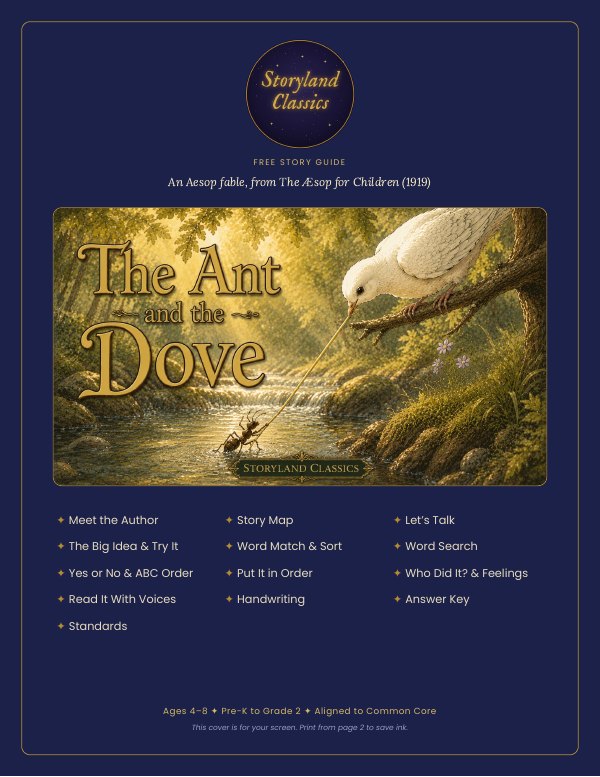
Cover of the The Dove and the Ant free story guide

The 15-page Story Guide for The Dove and the Ant, made for ages 4–8 (pre-K to grade 2) in the classroom, homeschool or at home. Here’s what’s inside:

  • A page for grown-ups with a story summary, a four-day plan and a QR code for the read-aloud
  • Meet the Author, with questions about the author
  • A story map with a picture from the read-aloud
  • Let’s Talk questions and a narration prompt
  • The Big Idea and a Try It activity
  • Word match, word sort and a word search
  • Yes or No? and ABC order
  • Put It in Order and a First-Next-Then-Last retelling
  • Who Said It? and a character feelings chart
  • Read It With Voices, handwriting practice, an answer key and a Common Core standards table

Standards: Common Core RL.K.1, RL.1.1, RL.2.1, RL.K.2, RL.1.2, RL.2.2, RL.K.3, RL.1.3, RL.2.3, RL.K.4, RL.K.6, RL.1.6, RL.2.6, RL.K.7, RL.1.7, RL.K.10, RL.1.10, RF.K.1b, RF.K.1d, RF.K.3c, RF.1.3, RF.1.4b, RF.2.4b, SL.K.1, SL.1.1, SL.K.2, SL.K.5, SL.K.6, L.K.1a, L.1.1, L.1.1a, L.K.2a, L.K.4, L.1.4, L.K.5a, W.K.1, W.1.1, W.K.2, W.1.8. A full standards table is included in the guide.

Download the Free Guide (PDF)

No sign-up needed. US Letter, prints well in black and white. See all teacher guides

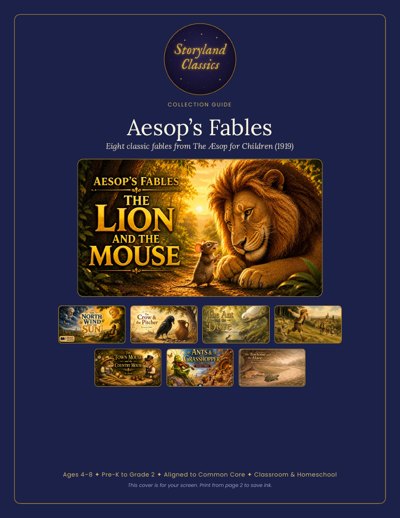
Cover of the Aesop’s Fables Collection Guide

✦ Library Card Bonus ✦

Teaching all eight fables?

Get the 84-page Aesop’s Fables Collection Guide free with your Library Card: all eight fables from the Aesop’s Fables compilation video, a two-week plan, a fable passport, six pages for every fable, activities that connect the fables, plan-and-write-your-own-fable pages, three readers’ theater scripts, a retelling rubric and certificate, full-color moral posters and answer keys.

Standards: Common Core RL.K.1, RL.1.1, RL.2.1, RL.K.2, RL.1.2, RL.2.2, RL.K.3, RL.1.3, RL.2.3, RL.K.4, RL.K.6, RL.1.6, RL.2.6, RL.K.7, RL.1.7, RL.K.10, RL.1.10, RF.K.1b, RF.K.1d, RF.K.3c, RF.1.3, RF.1.4b, RF.2.4b, SL.K.1, SL.1.1, SL.K.2, SL.K.5, SL.K.6, L.K.1a, L.1.1, L.1.1a, L.K.2a, L.K.4, L.1.4, L.K.5a, W.K.1, W.1.1, W.K.2, W.1.8. A full standards table is included in the guide.

✦ For Grown-Ups ✦

Good to Know About The Dove and the Ant

What is a “spar”?

A strong pole on a ship, used to hold up the sails. The fable compares the Ant clinging to the straw with a shipwrecked sailor holding on to a broken spar.

Can an ant really sting?

Many kinds can. Some ants sting and others bite, and either can be surprisingly painful for something so small, which is exactly why the man misses his aim.

Who was Aesop?

Aesop is remembered as a storyteller in ancient Greece more than 2,500 years ago, though little is known for sure about his life. His fables were passed down and retold for centuries. Our text comes from The Æsop for Children (1919), illustrated by Milo Winter.

What is the moral of The Dove and the Ant?

“A kindness is never wasted.” One good turn deserves another.

What age is The Dove and the Ant best for?

Ages 3 to 8. Fables are short enough for the youngest listeners, and the moral gives older children something to talk about and apply to their own lives.

What can I ask children after reading it?

How did the Dove help the Ant? How did the Ant help the Dove back? What is a kind thing you could do today?

Is The Dove and the Ant in the public domain?

Yes. Aesop’s fables are ancient, and the 1919 Æsop for Children text we use is in the public domain in the United States, so it is free to read, print and share.

Wondering about public domain or classroom use? Every text on Storyland Classics is free to read and share. See our FAQ for teachers and families.

✦ Keep Reading ✦

More Stories to Enjoy

More About This AuthorMeet Aesop →