The Crow and the Pitcher

One of Aesop’s Fables

Read aloud by Storyland Classics  ✦  1 min 08 sec  ✦  Watch on YouTube

🌙 Keep listening: this story is part of a longer collection. Aesop’s Fables Treasury (15 min), from 4:26 ↗

A thirsty crow finds a pitcher with a little water at the bottom, too low to reach. So he thinks of a clever plan, one pebble at a time.

✦ The Story ✦

Read the Fable: The Crow and the Pitcher

From The Æsop for Children (1919), the edition published online by the Library of Congress. Public domain.

In a spell of dry weather, when the Birds could find very little to drink, a thirsty Crow found a pitcher with a little water in it. But the pitcher was high and had a narrow neck, and no matter how he tried, the Crow could not reach the water. The poor thing felt as if he must die of thirst.

Then an idea came to him. Picking up some small pebbles, he dropped them into the pitcher one by one. With each pebble the water rose a little higher until at last it was near enough so he could drink.

The moralIn a pinch a good use of our wits may help us out.
✦ About the Story ✦

Using Your Wits

Aesop is said to have been a storyteller in ancient Greece more than 2,500 years ago. Whether or not he was a single real person, the short animal tales told under his name have been retold in almost every language, and each one ends with a lesson, or moral. This telling comes from The Æsop for Children, a 1919 collection illustrated by Milo Winter that is still a favorite with families and teachers.

This short fable is a favorite in classrooms because you can try it yourself with a glass of water and some pebbles. Scientists have even tested real crows with a version of this puzzle, and many of them work out the pebble trick just like the crow in the story.

✦ Talk About It ✦

Questions for Young Listeners

  • Why couldn’t the Crow reach the water?
  • How did the pebbles help?
  • Try it: put a little water in a tall glass and drop in pebbles. What happens?

✦ For Teachers, Homeschoolers & Families ✦

Free Story Guide

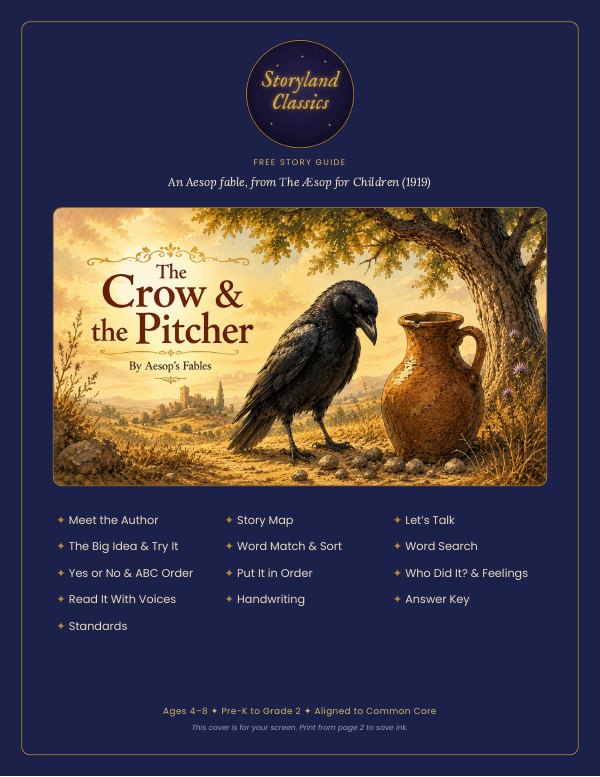
Cover of the The Crow and the Pitcher free story guide

The 15-page Story Guide for The Crow and the Pitcher, made for ages 4–8 (pre-K to grade 2) in the classroom, homeschool or at home. Here’s what’s inside:

  • A page for grown-ups with a story summary, a four-day plan and a QR code for the read-aloud
  • Meet the Author, with questions about the author
  • A story map with a picture from the read-aloud
  • Let’s Talk questions and a narration prompt
  • The Big Idea and a Try It activity
  • Word match, word sort and a word search
  • Yes or No? and ABC order
  • Put It in Order and a First-Next-Then-Last retelling
  • Who Said It? and a character feelings chart
  • Read It With Voices, handwriting practice, an answer key and a Common Core standards table

Standards: Common Core RL.K.1, RL.1.1, RL.2.1, RL.K.2, RL.1.2, RL.2.2, RL.K.3, RL.1.3, RL.2.3, RL.K.4, RL.K.6, RL.1.6, RL.2.6, RL.K.7, RL.1.7, RL.K.10, RL.1.10, RF.K.1b, RF.K.1d, RF.K.3c, RF.1.3, RF.1.4b, RF.2.4b, SL.K.1, SL.1.1, SL.K.2, SL.K.5, SL.K.6, L.K.1a, L.1.1, L.1.1a, L.K.2a, L.K.4, L.1.4, L.K.5a, W.K.1, W.1.1, W.K.2, W.1.8. A full standards table is included in the guide.

Download the Free Guide (PDF)

No sign-up needed. US Letter, prints well in black and white. See all teacher guides

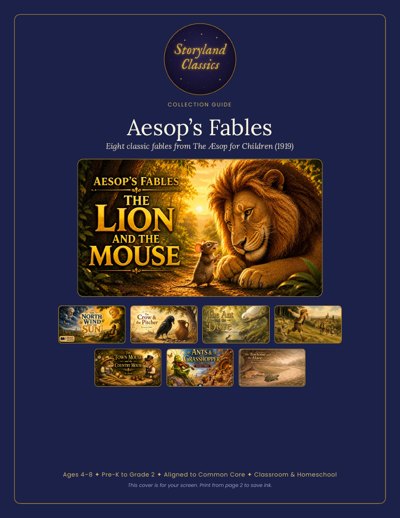
Cover of the Aesop’s Fables Collection Guide

✦ Library Card Bonus ✦

Teaching all eight fables?

Get the 84-page Aesop’s Fables Collection Guide free with your Library Card: all eight fables from the Aesop’s Fables compilation video, a two-week plan, a fable passport, six pages for every fable, activities that connect the fables, plan-and-write-your-own-fable pages, three readers’ theater scripts, a retelling rubric and certificate, full-color moral posters and answer keys.

Standards: Common Core RL.K.1, RL.1.1, RL.2.1, RL.K.2, RL.1.2, RL.2.2, RL.K.3, RL.1.3, RL.2.3, RL.K.4, RL.K.6, RL.1.6, RL.2.6, RL.K.7, RL.1.7, RL.K.10, RL.1.10, RF.K.1b, RF.K.1d, RF.K.3c, RF.1.3, RF.1.4b, RF.2.4b, SL.K.1, SL.1.1, SL.K.2, SL.K.5, SL.K.6, L.K.1a, L.1.1, L.1.1a, L.K.2a, L.K.4, L.1.4, L.K.5a, W.K.1, W.1.1, W.K.2, W.1.8. A full standards table is included in the guide.

✦ For Grown-Ups ✦

Good to Know About The Crow and the Pitcher

Why does the water rise when the Crow drops in pebbles?

Each pebble takes up space in the pitcher, pushing the water up around it. Scientists call this displacement, and it is the same reason a bathtub rises when you climb in.

Why does the Crow use small pebbles?

The pitcher has a narrow neck, so only small stones will fit through. It is a nice detail to point out when children try the experiment themselves.

Who was Aesop?

Aesop is remembered as a storyteller in ancient Greece more than 2,500 years ago, though little is known for sure about his life. His fables were passed down and retold for centuries. Our text comes from The Æsop for Children (1919), illustrated by Milo Winter.

What is the moral of The Crow and the Pitcher?

“In a pinch a good use of our wits may help us out.” Thinking carefully can solve a hard problem.

What age is The Crow and the Pitcher best for?

Ages 3 to 8. Fables are short enough for the youngest listeners, and the moral gives older children something to talk about and apply to their own lives.

What can I ask children after reading it?

What was the Crow’s problem? How did she solve it? Try it with a cup, water and pebbles!

Is The Crow and the Pitcher in the public domain?

Yes. Aesop’s fables are ancient, and the 1919 Æsop for Children text we use is in the public domain in the United States, so it is free to read, print and share.

Wondering about public domain or classroom use? Every text on Storyland Classics is free to read and share. See our FAQ for teachers and families.

✦ Keep Reading ✦

More Stories to Enjoy

More About This AuthorMeet Aesop →