Silver

A poem by Walter de la Mare, from Peacock Pie, 1913

Read aloud by Storyland Classics  ✦  1 min 34 sec  ✦  Watch on YouTube

🌙 Keep listening: this poem is part of a longer collection. Classic Fairy Tales & Bedtime Poems (50 min), from 49:15 ↗

On a still night, the moon walks through the countryside and touches everything with silver, from the thatch to the sleeping dog to the fish in the stream.

✦ The Poem ✦

Full Text of Silver

by Walter de la Mare, from Peacock Pie (1913). Public domain in the United States.

Slowly, silently, now the moon Walks the night in her silver shoon; This way, and that, she peers, and sees Silver fruit upon silver trees; One by one the casements catch Her beams beneath the silvery thatch; Couched in his kennel, like a log, With paws of silver sleeps the dog; From their shadowy cote the white breasts peep Of doves in a silver-feathered sleep; A harvest mouse goes scampering by, With silver claws, and silver eye; And moveless fish in the water gleam, By silver reeds in a silver stream.
✦ About the Poem ✦

A World Turned Silver

Walter de la Mare (1873–1956) was an English poet famous for quiet, dreamlike poems full of moonlight, mystery, and small sounds in the night. Peacock Pie, his 1913 book of rhymes for children, has never gone out of print.

“Shoon” is an old word for shoes, “casements” are windows, and a “cote” is a little house for doves. Count how many times the word “silver” appears: it is repeated so often that the whole poem seems to glow. Read it slowly and quietly, the way the moon moves.

✦ Talk About It ✦

Questions for Young Listeners

  • What does the moon wear on her feet?
  • How many silver things can you find in the poem?
  • Look out the window on a moonlit night. What turns silver?
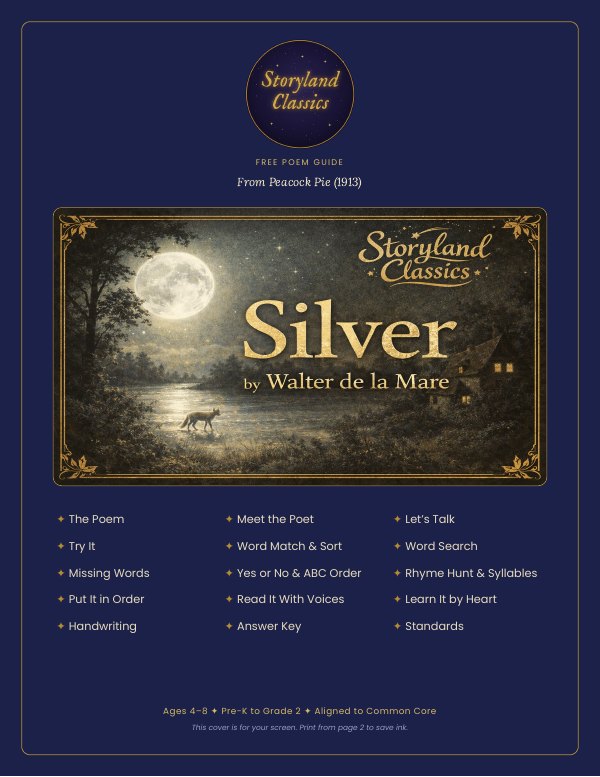
Silver free printable guide, cover page

✦ Free Printable ✦

The Silver Guide

17 printable pages  ✦  Pre-K to grade 2  ✦  US Letter  ✦  Ink-friendly

  • The full poem with a listen-along QR code, plus a page about the poet
  • Who Is Talking?, Let’s Talk questions and a narration prompt
  • A Try It activity built around one reading skill
  • Word match, word sort, word search and missing words
  • Yes or No?, ABC order, a rhyme hunt, syllable clapping and story order
  • Read It With Voices, Learn It by Heart with a certificate, and handwriting practice
  • An answer key and a full Common Core standards table

Standards: Common Core RL.K.1, RL.1.1, RL.2.1, RL.K.2, RL.1.2, RL.K.3, RL.1.3, RL.K.4, RL.2.4, RL.2.5, RL.1.6, RL.2.6, RL.K.10, RL.1.10, RF.K.1b, RF.K.1d, RF.K.2a, RF.K.2b, RF.K.3c, RF.1.3, RF.1.4a, RF.1.4b, RF.2.4b, SL.K.1, SL.1.1, SL.K.2, SL.K.6, SL.1.6, L.K.1a, L.1.1, L.1.1a, L.K.2a, L.1.2b, L.K.4, L.1.4, L.K.5a, W.K.1, W.1.1, W.K.2, W.1.8.

Download the free guide (PDF)

No sign-up needed. US Letter, prints well in black and white. See all teacher guides

✦ For Grown-Ups ✦

Good to Know About Silver

How many times does the word “silver” appear?

It appears many times in a short poem, describing the fruit, the thatch, the dog’s kennel, the doves, the mouse’s eyes, and more. Counting them together is a nice way to hear how repetition creates a mood.

Is Silver good for teaching poetic language?

Yes. It is full of alliteration, like “slowly, silently,” and old words like “shoon” and “casements.” Children can find the sounds that make the poem feel hushed.

Wondering about public domain or classroom use? Every text on Storyland Classics is free to read and share. See our FAQ for teachers and families.

✦ Keep Reading ✦

More Poems to Enjoy

More About This PoetMeet Walter de la Mare →