Little Red Riding Hood

The fairy tale in verse by Lydia L. A. Very, 1863

Read aloud by Storyland Classics  ✦  5 min 39 sec  ✦  Watch on YouTube

📱 Watching on a phone? Watch the full-screen vertical version ↗

🌙 Keep listening: this poem is part of a longer collection. 6 Classic Fairy Tales for Bedtime (40 min), from 10:43 ↗

The classic fairy tale told in rhyme: a kind girl, a cunning wolf, a little pot of butter for grandmamma, and a hunter who arrives just in time.

✦ The Poem ✦

Full Text of Little Red Riding Hood

by Lydia L. A. Very, from Red Riding Hood (Boston: L. Prang & Co., 1863). Public domain.

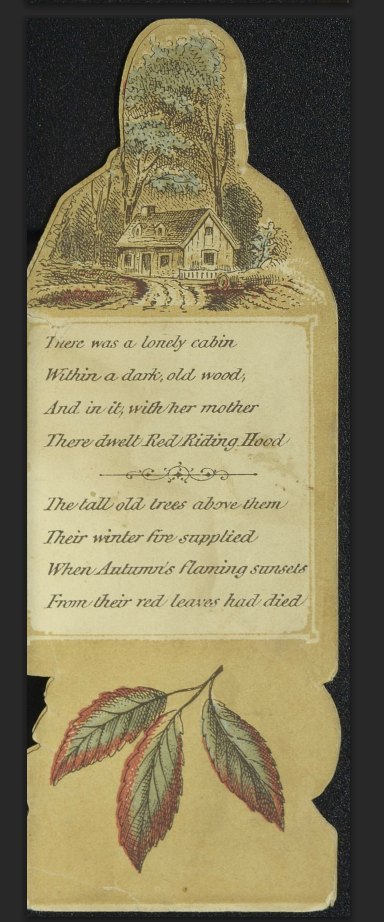
There was a lonely cabin Within a dark, old wood, And in it, with her mother There dwelt Red Riding Hood.

The tall old trees above them Their winter fire supplied When Autumn’s flaming sunsets From their red leaves had died.

The rippling brook, their water From far off mountains brought; And prattled of their summits In icy statues wrought.

For them, the squirrels hoarded Their nuts in hollow trees; And pounds of sweetest honey Were made them by the bees;

To gather these together Was work enough to do; Little Red Riding Hood thought so, And so, no doubt, would you.

Blushing beneath her fingers Looked up the berries red; The flowers seemed to know her And listened for her tread.

For she was good and loving And beautiful as good, With daily acts of kindness, Little Red Riding Hood.

Afar off, in the forest, There lived her grandam old; And she was poor and needy, And often sick and cold.

And once a week, her grandchild Would walk the lonely wood, And carry little bundles Of faggots and of food.

One morn the mother started The maid upon her way, And said, “now you must carry To grandmamma to day.”

“This little pot of butter I’ve churned so nice and sweet; And mind not stop and prattle With any one you meet!”

Then through the shady forest The little maiden went; And though her steps were fleetest, The day was well nigh spent,

When nearby through her journey, An old, gaunt Wolf she spied, Who wagged his tail, and humbly Came walking by her side;

And said, “my little maiden, How very fair you are! You really look quite handsome! Where do you walk so far?”

Forgetful of her mother, She stopped and told him where; Then said the Wolf, so cunning, “What is it that you bear?”

Forgetful of her mother, She stood and told him what; “’Tis butter, for my grandma, Packed nicely in this pot.”

Then said the Wolf, “good by dear; Perhaps we’ll meet again!” Then swiftly on he hastened, Swiftly through dale and glen,

And running reached before her The cabin grey and old; Her grandmamma was absent— He quickly did infold

Himself in cap and night gown Then quickly on the bed, Closely upon the pillow He laid his grizzly head.

Red Riding Hood soon entered; “O, grandmamma, see here! A little pot of butter!” Where is my grandma dear?

“Here,” said the Wolf, well feigning, Her grandma’s voice, so weak; “I’m here, so sick my darling, That I can scarcely speak!”

“Take off your clothes my darling, Upon the bed come lie; When you are here beside me I’ll be better by and by!”

Red Riding Hood obeyed her And got upon the bed; “O grandmamma how altered You are!” she quickly said

“O what GREAT EYES my grandma! They never looked so before—” “That’s to see you the better my darling, The larger, to see you more!”

“What a GREAT NOSE my grandma It never looked so before!” “That’s to smell you better, my darling; The larger to smell you more!”

“And what GREAT HANDS my grandma They never looked so before!” “That’s to hold you tight my darling And to hug you more and more!”

“What a GREAT MOUTH my grandma! As large as your tin cup!” “That’s to open wide my beauty And then to eat you up!”

Then he opened his great mouth wider To eat her like a bird But at that dreadful moment A hunter’s gun was heard

The Wolf fell dead and bleeding— Then grandma hastened in— For she had seen the peril The danger that had been!

Red Riding Hood wept sadly And sorrowed more and more, That she’d disobeyed her mother— Which she never did before.

And she thought with fear & trembling Of the death that came so near! And she said the fright had taught her To mind her mother dear.

Then listen, all ye children, And mind your mother’s word! For the great WOLF, men call EVIL Is prowling round unheard!
✦ About the Poem ✦

America’s First Shape Book

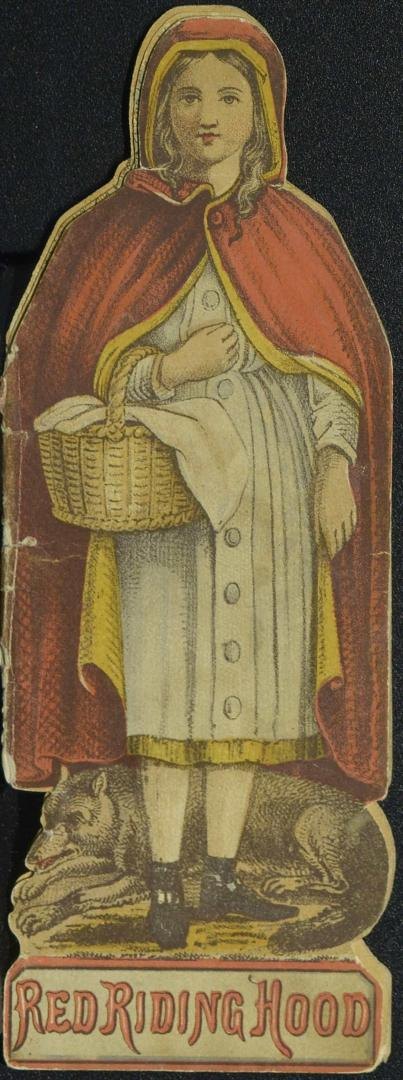
Lydia Louisa Anna Very (1823–1901) was a poet and artist from Salem, Massachusetts. In 1863 she wrote and designed this rhyming version of the old fairy tale for the Boston publisher Louis Prang, and the little book was cut into the shape of Red Riding Hood herself, with the wolf curled at her feet. It is thought to be the first “shape book” published in the United States.

Very’s version follows the familiar story from the Brothers Grimm and Charles Perrault, but she gives it a gentler ending: a hunter arrives in time, grandmamma is safe, and Red Riding Hood learns to mind her mother’s words.

✦ Talk About It ✦

Questions for Young Listeners

  • What was Red Riding Hood taking to her grandmother?
  • What did her mother tell her not to do on the way? Did she listen?
  • Which “GREAT” thing about grandma did Red Riding Hood notice first?
The 1863 Red Riding Hood shape book, cut out in the shape of the girl with the wolf curled at her feet
The cover, 1863
A page from the 1863 Red Riding Hood shape book with the opening verses
The first page

✦ Did You Know? ✦

America’s First Shape Book

The poem on this page first appeared in 1863 as a little book cut out in the shape of Red Riding Hood herself, with the wolf curled at her feet. Lydia L. A. Very, a Salem schoolteacher, wrote the verses and designed the book, and the Boston printer Louis Prang published it. It is credited as the first book in America shaped like a person or an animal.

The original is in the public domain, so you can page through all sixteen pages yourself.

Scan of the original 1863 book courtesy of the Toronto Public Library Digital Archive (public domain).

✦ For Teachers, Homeschoolers & Families ✦

Free Poem Guide

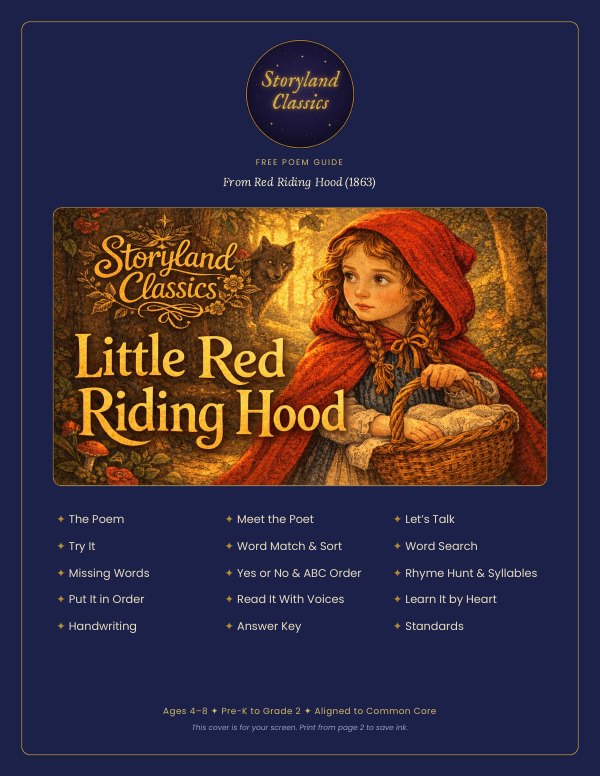
Cover of the Little Red Riding Hood free poem guide

The 18-page guide for Lydia Very’s rhyming Little Red Riding Hood, made for ages 4–8 (pre-K to grade 2) in the classroom, homeschool or at home. Here’s what’s inside:

  • The full poem with a listen-along QR code, plus a page about the poet
  • Who Is Talking?, Let’s Talk questions and a narration prompt
  • A Try It activity built around one reading skill
  • Word match, word sort, word search and missing words
  • Yes or No?, ABC order, a rhyme hunt, syllable clapping and story order
  • Read It With Voices, Learn It by Heart with a certificate, and handwriting practice
  • An answer key and a full Common Core standards table

Standards: Common Core RL.K.1, RL.1.1, RL.2.1, RL.K.2, RL.1.2, RL.K.3, RL.1.3, RL.K.4, RL.2.4, RL.2.5, RL.1.6, RL.2.6, RL.K.10, RL.1.10, RF.K.1b, RF.K.1d, RF.K.2a, RF.K.2b, RF.K.3c, RF.1.3, RF.1.4a, RF.1.4b, RF.2.4b, SL.K.1, SL.1.1, SL.K.2, SL.K.6, SL.1.6, L.K.1a, L.1.1, L.1.1a, L.K.2a, L.1.2b, L.K.4, L.1.4, L.K.5a, W.K.1, W.1.1, W.K.2, W.1.8.

Download the Free Guide (PDF)

No sign-up needed. US Letter, prints well in black and white. See all teacher guides

✦ For Grown-Ups ✦

Good to Know About Little Red Riding Hood

Is this version too scary for young children?

It is gentler than many. The wolf is clever rather than gruesome, and a hunter arrives in time, so grandmamma and Red Riding Hood are both safe at the end.

How does this version differ from the Grimms’ story?

The Grimms’ wolf swallows both grandmother and girl before the huntsman cuts them free. Very’s version keeps the familiar dialogue but softens the danger and closes with a lesson about listening to mother.

What was the first shape book?

Lydia L. A. Very’s Red Riding Hood, published by Louis Prang in Boston in 1863, is credited as the first American book cut into the shape of a person or animal: a standing Red Riding Hood with the wolf at her feet. The poem on this page is its text.

Can I see the original 1863 Red Riding Hood book?

Yes. The original is in the public domain, and a scan of all sixteen pages is linked on this page.

Wondering about public domain or classroom use? Every text on Storyland Classics is free to read and share. See our FAQ for teachers and families.

✦ Keep Reading ✦

More Poems to Enjoy

More About This PoetMeet Lydia L. A. Very →